
Fabricators, repairmen, and installers of steel, aluminum, and other sheet alloys are known as “sheet metal workers.” Sheet metal work is important in the industrial and construction industries and offers opportunities for financial reward and personal growth to those who possess the necessary skills.
As the globe continues to industrialize, there will always be a demand for skilled sheet metal workers to perform a wide range of tasks in a number of settings. Let’s take a look at the duties, traits, and training needs of modern sheet metal workers.
You can use your VA education benefits to become certified and trained as a sheet metal worker if it is a career path you are interested in pursuing. What you need to know is as follows.
What Does a Sheet Metal Worker Do?
Sheet metal workers fabricate, set up, and fix sheet metal products, as previously indicated. Ducts for HVAC systems and other ventilation systems are a common product of fabrication. Drainage and roofing-related items are another common focus for sheet metal craftsmen.
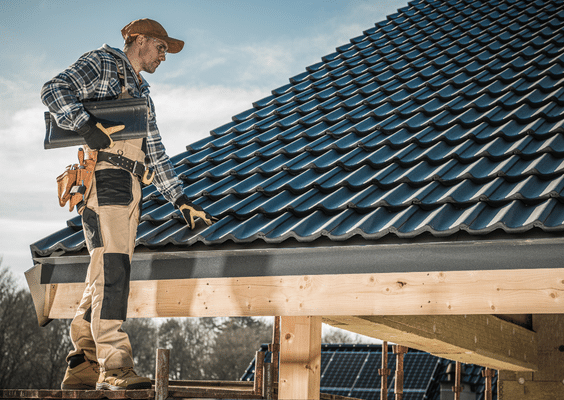
Your daily responsibilities as a sheet metal worker may change significantly depending on the specialty you choose to pursue. A sheet metal installer is someone who puts up siding, gutters, and air conditioning ducts.
Sheet metal workers in maintenance fix and clean ventilation systems to keep them in working order. They clean the ducts of debris and moisture and repair any holes or tears in the metal.
Precision sheet metal workers frequently produce components for the energy sector and the medical device industry. Because of the prevalence of computers in their line of work, they must be proficient in using such devices.
Sheet Metal Workers Need These Extra Skills and Qualifications
In addition to learning the basics of manufacturing, installation, and maintenance, successful sheet metal workers typically exhibit the following talents and personality traits:
Manual Dexterity:
Sheet metal work is precise and calls for deft hands. You should be competent with measuring instruments and the operation of heavier machinery. To succeed in this field, you’ll need to be able to work with your hands and produce goods of consistent size and quality.
Attention to Detail :
Due to the delicate nature of sheet metal work, meticulous accuracy is essential. Patience is required while reading blueprints and other directions in order to effectively translate those needs onto metal. Being careful to avoid even the smallest of errors is essential while working on huge projects.
Skills in mathematics and mechanics:
Sheet metal craftsmen, as we’ve shown, have a strong mechanistic bent and rely heavily on mathematics to do quality work. A solid understanding of geometry is crucial since you will be transforming a two-dimensional metal sheet into a three-dimensional object.
A mechanically oriented mind must also have the ability to imagine how a project will turn out.
Strength and Endurance:
It takes a lot of muscle and energy to lift and manipulate heavy metal sheets all day long. Workers in the sheet metal industry need to be able to regularly lift more than 50 pounds.
Where Would You Work As A Sheet Metal Worker?
Sheet metal workers can find work in a variety of industries and contexts because to the wide range of items that require their services. The following are examples of common workplaces for those who deal with sheet metal.
The dangers of working with sheet metal extend beyond the specifics of any one workplace. Sharp metal, welding, falls, and equipment are all potential causes of injury on the job.
Industrial Complexes:
Sheet metal workers are frequently needed in factories and other industrial settings.
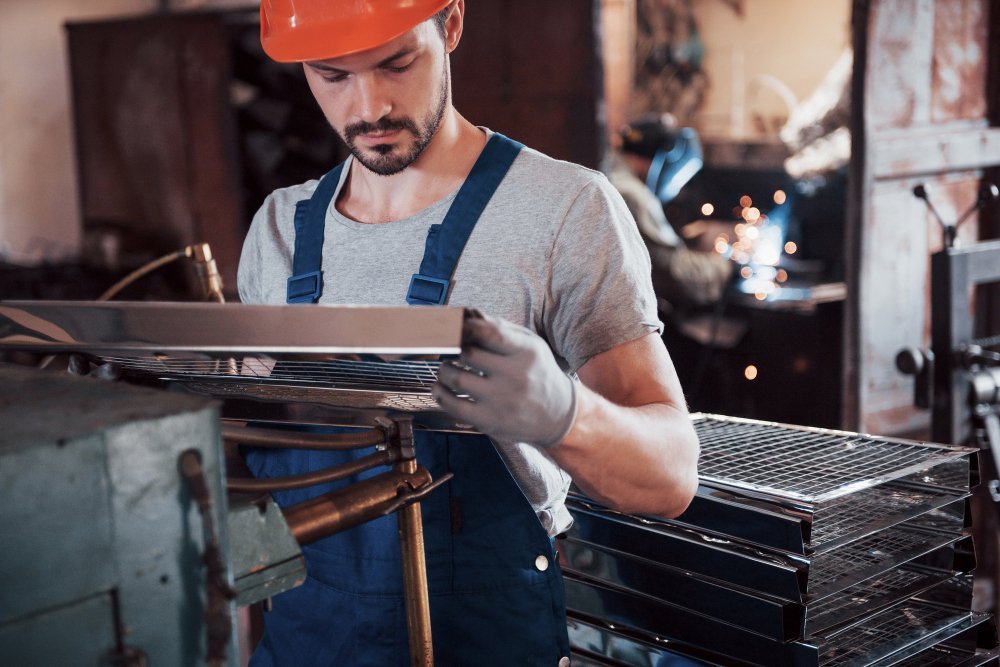
Most people with skills in precision sheet metal work in factories where they operate a wide variety of machines. Workers in factories often engage in routine motions and operate complex pieces of machinery.
Consider working at a major manufacturing facility if you thrive on regularity and are interested in the more technological aspects of sheet metal production.
Building Sites:
Sheet metal craftsmen are frequently in demand on building projects.
Sheet metal workers are needed by some construction firms to install ductwork and fabricate other metal tools and fixtures. Sheet metal workers on construction sites are responsible for making, fixing, and installing metal components.
Applying at a construction site might be difficult because of the environment, the noise, and the other workers.
Local Businesses:
In order to meet the unique needs of their customers, small businesses often employ small, tightly knit teams of sheet metal workers.
A small shop is the only other significant working choice for sheet metal workers. Some skilled laborers set up shop as independent fabricators of sheet metal. Because of the lack of huge factories, small businesses thrive in these communities.
Smaller businesses are great options if you enjoy working in an intimate setting with a tight-knit group of coworkers. Keep in mind that landing a job can be trickier than you thought.
Services Provided By Sheet Metal Workers
Workers that specialize in sheet metal employ a wide range of methods to cut, bend, and shape metal sheets into the necessary parts for a variety of goods. Components with exact dimensions and tolerances are the result of their usage of equipment like saws, shears, lasers, and presses. Construction, manufacturing, and transportation are just some of the many fields that can benefit from these parts.
Sheet metal workers are needed in many different industries to install sheet metal parts. They may work on the HVAC (heating, ventilation, and air conditioning) systems of buildings or on the roofing of homes and businesses using sheet metal. Installing components properly and securely relies on their ability to read and interpret blueprints and design requirements.
Repair and maintenance services for sheet metal parts are another service offered by sheet metal professionals. Inspecting and cleaning ducting, performing periodic maintenance, and repairing or replacing broken parts are all tasks that fall within the purview of HVAC technicians. These maintenance procedures aid in extending the life and reliability of sheet metal parts.
In addition to standard services, sheet metal craftsmen can create unique products for their customers. Whether it’s a custom HVAC system or an unusual architectural element, they can make it to order. It takes a lot of expertise and imagination to come up with solutions that are both secure and useful for the customer.
Salaries of Sheet Metal Workers
The BLS reports that in May of 2020, sheet metal workers earned a median annual salary of $51,370. Only 10% of the population made less than $32,620, while the top 10% made over $86,480. Remember that factors such as location, years of experience, and industry might affect real pay. Certified and experienced sheet metal workers may also command greater wages.
Steps To Become A Sheet Metal Worker
Here are the steps you may take to enter the field of sheet metal work:
Apprenticeship programs for sheet metal workers often require students to have completed high school or its equivalent. A General Equivalency Diploma (GED) can be earned in place of a high school diploma.
Apprenticeships for sheet metal workers often span four to five years and incorporate both classroom and on-the-job learning. Apprentices are trained in the areas of reading blueprints, working with HVAC systems and ducts, and fabricating and installing sheet metal goods.
When your apprenticeship is complete, you can test for your journeyman’s license. Your expertise with HVAC ducts and systems, as well as sheet metal fabrication, will be put to the test. Passing the test will qualify you for journeyman status in the sheet metal industry.
Get Your License
Conducting a History Verification
You will need to submit to a background check before submitting your license application. This is to guarantee that your prior record does not preclude you from working in the metalworking industry. The background check will normally look at your career history, educational background, and any criminal records.
To satisfy this requirement in the state of Florida, applicants must use an approved supplier for electronic fingerprinting services, as specified by the Florida Department of Business and Professional Regulation (DBPR). The Florida Electronic Fingerprinting Service is a widely utilized authorized provider.
License Application
You will be able to apply for a license after passing the required background check. To find out the precise requirements for licensure in your state, you need contact the licensing board in that state. Application forms, fees, and verification of previous experience and education are the norm.
Getting Ready for the Test
Sheet metal workers are required to obtain a license in several states. Safety procedures and regulations, as well as manufacturing, installation, and repair of sheet metal, will all be on the test. Depending on your level of background knowledge and experience, you may require several months to study for the test.
Your sheet metal worker license will be issued once you have successfully completed the examination and all other criteria. You may now legally work as a sheet metal worker in your state with the help of this license. It’s important to remember that maintaining your license may need regular renewal and attendance at approved continuing education programs.
In order to advance in the field, sheet metal workers can further their education and earn credentials in subfields like welding, CAD (computer-aided design), and project management. Earning a degree or certificate can improve your employment prospects and salary.
Using Your VA Educational Benefits, You Can Become a Sheet Metal Worker
You may be able to use your Veteran Affairs education benefits to train for a career in sheet metal work if you are a veteran. Among the VA’s many helpful programs are the following:
- The Veterans Benefits Act of 2003: Eligible veterans can receive financial aid for higher education expenses including tuition and fees, a housing allowance, and a stipend for books and supplies thanks to the Post-9/11 GI Bill. A minimum of ninety days’ active duty after September 10, 2001 is required for eligibility.
- Veterans who have served in the armed forces and have paid into the Montgomery GI Bill program are eligible to receive educational benefits. Up to 36 months of college or vocational school can be paid for with this benefit.
- Veterans with service-connected impairments can get financial aid for school through the Vocational Rehabilitation and Employment (VR&E) Program. Education expenses, living expenses, and help finding a job are all covered.
- Tuition and expenses for qualifying active duty military personnel are covered by the Department of Defense’s Military Tuition Assistance (TA) program. Sheet metal worker apprenticeship programs may be eligible for funding under TA for active duty service members.
Certifications
Sheet metal workers who take the time to earn relevant certifications can stand out in an increasingly competitive job market. Certification needs may differ based on your geographic region and area of expertise.
Sheet Metal and Air Conditioning Contractors' National Association (SMACNA) Certification:
HVAC Air Duct Leakage Test Technician Certification and Fire Smoke Damper Technician Certification are only two examples of the certificates offered by the Sheet Metal and Air Conditioning Contractors’ National Association (SMACNA). These credentials attest to one’s ability to examine, test, and maintain fire smoke dampers and air ducts.
National Center for Construction Education and Research (NCCER):
Both the NCCER Core Certification and the NCCER Sheet Metal Level 1 Certification are available from NCCER for anyone interested in careers in sheet metal work. These credentials attest to a candidate’s proficiency with basic sheet metal techniques, construction tools, and materials.
North American Technician Excellence (NATE):
Certification from the North American Institute of Heating, Refrigeration, and Air Conditioning (NATE) is highly sought after by HVAC specialists, particularly sheet metal workers. The HVAC fields of air conditioning repair, ductwork installation, and heat pump maintenance are all covered by NATE qualifications. These credentials attest to specialized knowledge of HVAC systems.
Certifications from the Occupational Health and Safety Administration (OSHA):
Sheet metal workers might benefit from general OSHA certificates like the 10-Hour or 30-Hour Construction Safety Certification. Safety in the workplace is prioritized throughout these qualifications.
American Welding Society (AWS) Certifications:
Welders in the sheet metal industry can choose from a variety of AWS qualifications. The Certified Welder (CW) credential is for people who wish to demonstrate their mastery of certain welding processes, while the Certified Welding Inspector (CWI) credential is geared for those who wish to check and certify welds.
Last Words
The sheet metal industry has matured to the point that it can provide a wide variety of services to a number of diverse markets. Sheet metal workers are skilled in creating, installing, repairing, maintaining, and tailoring a wide variety of sheet metal products and components. According to BLS data, the median annual salary for sheet metal workers is $51,370.
If you are a veteran and would want to pursue a career in sheet metal work, you may be qualified for VA educational benefits, which may give financial aid for training and schooling that will equip you with the skills and knowledge you need to succeed in the field. Check your credentials at [fheps.com], look at local apprenticeships and training programs, and contact your regional VA office to learn more about any benefits you may be eligible for.